Exploring Hydraulic Press Machines: How They Work
Hydraulic press machines have become an essential part of various industries, from manufacturing to automotive, owing to their versatile applications and efficient force multiplication capabilities. Woodmac Group is a Hydraulic presses manufacturer that offers quality and reliable H Frame Press, C Frame Presses, Forklift Tire Presses, and a Gantry Straightening Presses in CANADA and USA.

The Basics of Hydraulic Press Machines
What Are Hydraulic Press Machines?
Hydraulic press machines are powerful devices designed to generate a compressive force using hydraulic cylinders. These machines are extensively used for various applications that require the shaping, molding, or compression of materials.
The Key Components
Hydraulic press machines consist of several essential components:
- ⧫ Hydraulic cylinders ⧫ Hydraulic pump ⧫Control valve ⧫Reservoir ⧫Piston
The Working Principle
Pascal's Law
The operation of hydraulic press machines is based on Pascal's Law, which states that when pressure is applied at any point in a confined fluid, it is transmitted undiminished throughout the fluid in all directions. This law allows for the efficient transfer of force from a small piston to a larger one.
Force Multiplication
Hydraulic press machines employ force multiplication by using a small force on the piston to create a much larger force on the larger piston. This mechanism allows for the application of enormous pressure, making hydraulic press machines suitable for various heavy-duty tasks.
Types of Hydraulic Press Machines
Hydraulic press machines come in various configurations, including:
H-Frame Press
The H-frame press is characterized by its H-shaped frame, which provides stability and versatility for a wide range of applications.
C-Frame Press
The C-frame press features a C-shaped frame design, which is ideal for tasks requiring a compact and efficient setup.
Four-Column Press
The four-column press has a robust structure with four columns for stability and precision during operations.
Arbor Press
Arbor press machines are smaller and manually operated, making them suitable for lighter tasks.
Applications of Hydraulic Press Machines
Metal Forming
Hydraulic press machines are widely used in metalworking industries for bending, forging, and forming metal sheets and parts.
Material Testing
These machines are essential in material testing laboratories for evaluating the strength and durability of various materials.
Plastic Compression Molding
Hydraulic presses are used in the plastic industry for compression molding of plastic products, such as automotive parts and consumer goods.
Advantages and Disadvantages
Advantages
- ⧫ High force output⧫ Precise control⧫ Versatile applications⧫ Efficient energy usage
Disadvantages
- ⧫ Initial cost⧫ Regular maintenance required
Maintenance and Safety
Proper maintenance and safety procedures are crucial for the reliable and safe operation of hydraulic press machines. Regular inspections, lubrication, and employee training are essential for preventing accidents and ensuring machine longevity.
Hydraulic Press Machine Cost
The cost of hydraulic press machines varies based on factors such as size, capacity, and brand. Small, manual arbor presses may cost a few hundred dollars, while large industrial presses can reach several thousand dollars.
Conclusion
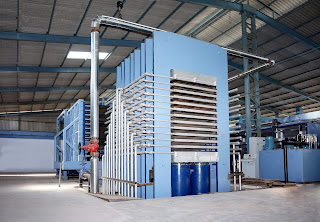
Hydraulic hot presses for Plywood machines are vital tools that have revolutionized various industries by providing the force required for heavy-duty tasks. Understanding their working principle, types, applications, advantages, and maintenance is essential for making the most of these powerful machines.



Comments
Post a Comment